DETOXING METHODS
These are some ways we detox from Lyme Disease toxins.
*This is not medical advice! ~This is how my family manages detoxing.
Not mentioned in the video below is our habit of eating organic foods. I can’t believe I forgot to mention beloved dandelion. Dandelion greens are great in salads and we love dandelion root tea. Juicing (lots parsley & celery juice) as well as intermittent fasting are wonderful aids in our detox process. Only the adults in our home use internment fasting! All of our medical team feels fasting is not appropriate for children. With my boys constant need to fuel up I’m not going to push that!
Some people find pectin to be a great toxin binder. Some people use Earthing to assit detox. The Earthing concept is basically to go outside on a clean unpolluted ground barefoot, be conductive to the Earth's natural frequency energy. When I was bed bound we slept on an Earthing sheet. It was hard for me to feel at ease outside in nature after getting sick with Lyme and living in a tick infested environment. After we moved away from Mendocino County, CA to the mountains of Western North Carolina where we could be in nature again without having 20 ticks crawling on us at any given moment I realized how nature starved I was. It’s a funny thought because I lived on 40 acres of rolling hills outside of Willits, CA but I could hardly enjoy it. Being able to sit next to a wildflower lined creek or river or lay in a meadow without constantly tick checking has been profoundly healing for our family.
Along side the thoughts of Earthing, we like to wear natural fiber clothing like cotton, wool, silk, etc to help us be better conduits of nature’s energy.
Good sleep is also a vital part of detox. It’s my understanding that during sleep, the flow of cerebrospinal fluid increases dramatically to the brain. The fluid helps wash away harmful waste that builds up between brain cells during waking hours. Insomnia can be a very frustrating symptom of Lyme. I do whatever I can to promote good sleep. I drink nervine teas before bed. Oat straw and milky oats is one of my favorites along with chamomile. I take prolonged release melatonin. I take a large dose of magnesium and CBD oil before bed. I try not to do computer work late at night. Sometimes I use crampbark to keep muscle twitches at bay. I need my sleeping area to be completely dark. I have no tolerance for any bit of street light or LED glare from a smoke detector or electronic device. When I sleep in a hotel I need to bring dark fabric and electrical tape to cover all those little blue lights from TVs or arm clocks otherwise I will not get a wink. I encourage you all to experiment and see what works best for your sleep. Some people like weighted blankets or a colder room to sleep in. Find what works for you.
I should mention that some people have little problems detoxing. I have a dear friend who was in terrible pain from Lyme Disease. She finally went to a LLMD and got on doxycycline. She felt fantastic while on doxy and she even started running again. When I went on doxy, I thought I was going to die. We are all so different. Each person's needs are unique. Some people have genetic variants that compromise their ability to detox well. ~ I’m one of those people which is probably why I was motivated to try all these methods.


*The statements made in the video and and on this page are not approved by the FDA. LymeCompass.net is NOT offering medical advice. This information is for educational purposes only. Do not disregard professional medical advice or delay seeking it because of something you heard or read on this website
ASHWAGANDHA
#43- Ashwagandha, Withania somnifera
We’re coming to the end of the 2018 growing season here in Western NC. We've just got the Ashwagandha and Red Sage to harvest and process. We're still bringing in lots of Tulsi and the second round of Milky Oats but autumn is certainly in the air and frosts are predicted next week.
We’ve been growing Ashwagandha since 2002. This year the plants were munched on hard by the insects and our cool wet rainy summer didn’t help the plants to thrive. Even though the plants are not in their ultimate prime, it would be a shame not share the many beneficial properties of Ashwagandha. We love this plant so much!
Ashawagandha is also known as Indian Ginseng. One thing I didn’t mention in the video is that many people claim that Ashawagandha helps increase their libido. It makes sense that a healthy libido is an expression of increased energy and vitality.
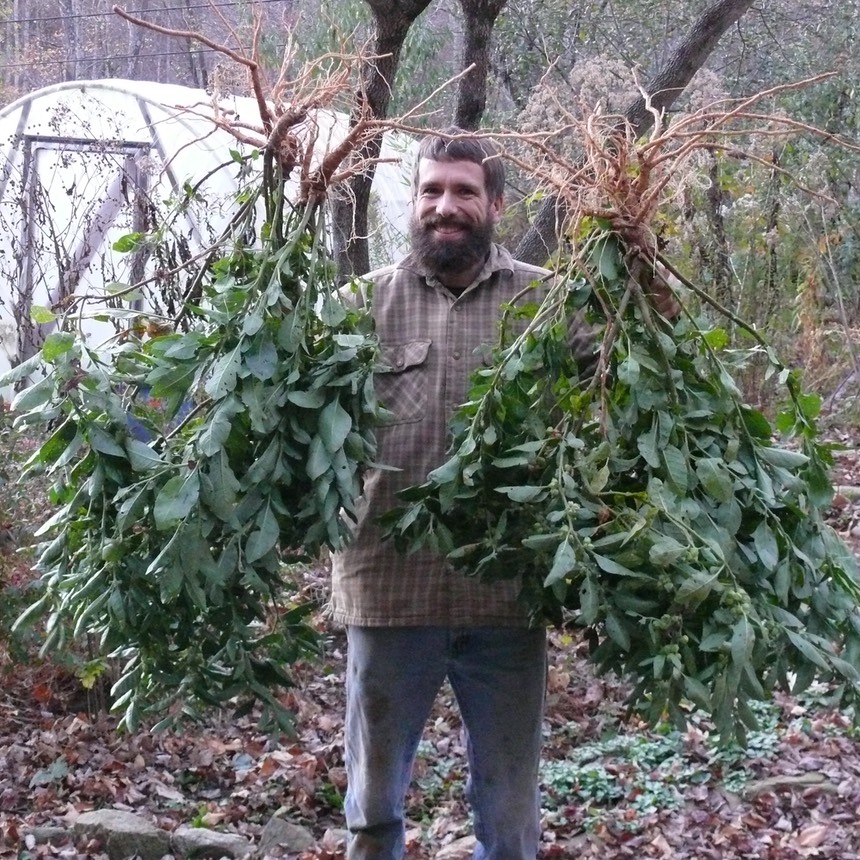
This may be the one of the last 2018 season garden videos, but I have plans to make you guys a detox video and show you what supplements I do buy to help stay in balance…
Articles:
Stranger Things About Ashwagandha Benefits For Men vs. Women
Ashwagandha may be drug candidate to treat aggressive cancer
5 Ashwagandha Studies You Should Know About
Ashwagandha by Gayle Engels & Josef Brinckmann, HerbalGram
Promising 'natural' Alzheimer's treatment moves toward clinical trials
Research:
An Overview on Ashwagandha: A Rasayana (Rejuvenator) of Ayurveda
Scientific Basis for the Therapeutic Use of Withania somnifera (Ashwagandha): A Review
Studies on the immunomodulatory effects of Ashwagandha
Anxiolytic-antidepressant activity of Withania somnifera glycowithanolides: an experimental study
Withania somnifera (Ashwagandha): A Promising Remedy for Cardiovascular Diseases
Ashwagandha and Cancer Research:
Ashwagandha has capacity to deal with complicated cancers
*The statements made in the video and and on this page are not approved by the FDA. LymeCompass.net is NOT offering medical advice. This information is for educational purposes only. Do not disregard professional medical advice or delay seeking it because of something you heard or read on this website
RED ROOT
#42- RED ROOT, Ceanothus americanus
Ceanothus americanus is a perennial bush that grows about 3’ tall. It gets white flowers that bloom May-June in Western NC. It grows from Texas on eastward. There are may different Ceanothus species throughout North America and many have medicinal uses. Ceanothus americanus is a well known lymphatic mover. It has been used to treat chronic or acute infections where the swelling of the spleen and swollen lymph nodes are present. Red root has become a staple in the treatment of Bartnolla and helps the body clean up from the damage done from Babesia. It is not recommended for long term use, but you can switch it out with gentle lymph movers and return to its use again after a break.

Other suggestions to keep the lymphs moving:
Eat your spring greens; dandelion, cleavers, chickweed, etc.
Dry brush
Sauna therapies
Wear loose clothing
Deep breathing
Exercise ~I know this is hard for many people with Lyme but even gentle movement can help move the Lymphs and swimming is great exercise and gentle on the body
The Lymphatic System:

Chart credited to: https://www.thewnc.net/love-your-lymph/
The chart above does not include the brain, and guess what, it’s all connected… and science is slowly catching up: Brain cleaning system uses lymphatic vessels
Articles:
Michael Moore made a great map of different Ceanothus species
Fragrant Red Root, Ceanothus by oreen Shababy
*The statements made in the video and and on this page are not approved by the FDA. LymeCompass.net is NOT offering medical advice. This information is for educational purposes only. Do not disregard professional medical advice or delay seeking it because of something you heard or read on this website
ASTRAGALUS
Blog #41- ASTRAGALUS, Astragalus membranaceus
Astragalus is a well known immune tonic. The roots of the plant are used. It can take several years for the plant to grow enough root stock to be able to harvest. Depending on conditions it can take 3-5 years before one can harvest. The roots are harvested in the fall. The roots can be thinly sliced and dried for later use. It makes a lovely tea and is wonderful to add in bone broth or soup stock. The plant prefers well drained soil. Astragalus does not like it’s roots damp. It is easy to grow. It can grow 4-5” tall. It produces delicate yellow flowers from midsummer through late autumn and forms a small pea like seed pod. Astragalus is in the legume family. It fixes nitrogen into the soil and can make a long term cover crop.
Astragalus is one of those herbs that I don’t think to tincture. It is one that I think of as food. I sometimes cook rice or quinoa in Astragalus decoction. If you do choose to tincture it, many find that a combined alcohol and water extraction makes the best medicine. Some people make a strong decoction and stabilize it with alcohol, so it is shelf stable at 25-30% alcohol. Astragalus can help strengthen the digestive system and nourish the respiratory system. In the video, I find myself questioning the claims that Astragalus is the ultimate herb for Lyme. For many, it is indeed very helpful, but Lyme treatment is not a one size fits all approach.
Dr. Axe’s article on Astragalus
Research:
https://www.ncbi.nlm.nih.gov/pmc/articles/PMC5758356/
Anti-Aging Implications of Astragalus Membranaceus (Huangqi): A Well-Known Chinese Tonic
Astragalus saponins Inhibits Lipopolysaccharide-Induced Inflammation in Mouse Macrophages
In vitro and in vivo anti-tumor effects of Astragalus membranaceus
*The statements made in the video and on this page are not approved by the FDA. LymeCompass.net is NOT offering medical advice. This information is for educational purposes only. Do not disregard professional medical advice or delay seeking it because of something you heard or read on this website.
MOTHERWORT
#40, MOTHERWORT, Leonurus cardiaca
Motherwort is a perennial in the mint family. It blooms in late summer. The blossoms are tinctured fresh or dried and capsulated into medicine. Some folks enjoy Motherwort tea, but I find it too bitter for my liking. Its bitter nature does help strengthen digestion.
Motherwort has been a very helpful herb for me. I think parenthood is hard even for those abundantly blessed with all the support and money they wish. I often feel rather alone in the challenge of having Lyme disease and caring for children who have it also. I have little family support besides my husband. My family and my husband’s family are not physically present in our children’s lives. They will give a call or send a card once in a while, but there’s no one to call to come over when there are great joys or sorrows at hand. There is no family gathered around my children to sing them happy birthday. I see people who have a loving supportive family as the richest people in the world! Sometimes I imagine that I have a Mama to call to come help when everyone is herxing or pain levels are high. I think that must be the most wonderful feeling in the world, to have someone who loves you and wants to help and support you. I’m trying to be that kind of parent for my own children.
From the videos or Instagram feed, you may think I have this pristine life, and in many ways I do, but somedays I want to run from the constant struggle of Lyme, but whenever I go, there it is.… Sometimes I want forget about treatments and thoughts of who needs what therapy or special meal plan. Some days I want to run or dance my worries away and yet my physical body won’t even allow such relief, so I sit quietly. I breath. I stretch. I dig. I make compost. I plant and weed things. I walk slowly in nature and try with my all my might and will to fulfill this role, this task being asked of me in the most loving way possible. Sometimes it feels too heavy and I will surely dissolve but I’m still here plodding along. Managing a family with chronic Lyme is enough to make even the kindest most compassionate person a bit crazy. So Motherwort, despite what some say about its possible thyroid side effects keeps me sane. It keeps me calm. It helps me have a courageous heart and be creative for my children when it feels like my inner well is dry. I am so very grateful for its help!

Research:
Leonurus cardiaca L. (motherwort): a review of its phytochemistry and pharmacology
Motherwort (Leonurus cardiaca)
*The statements made in the video and on this page are not approved by the FDA. LymeCompass.net is NOT offering medical advice. This information is for educational purposes only. Do not disregard professional medical advice or delay seeking it because of something you heard or read on this website.
GREATER CELANDINE
#39 GREATER CELANDINE, Chelidonium majus
My husband, Jem, has had Lyme since childhood. He had some serious neurological complications from it. His word forming and speech were really impaired. Most people thought he was really shy and often didn’t understand that he really couldn't come up with the words to speak. We’ve been treating for decades. He’s tried everything under the sun, allopathic and natural.
Last year, he finally did the DNA Connexions urine test. We learned that he was harboring Ehrlichia, a co-infection that we never thought to treat because ehe never before tested positive for it. We were treating from an angle of Babesia and Bartonella but completely missed Ehrlichia. Jem began herbal treatment which included Greater Celandine. My husband is not cured but oh my goodness the difference is immense. Sometimes pulling back those layers of co-infections are so vital to be able to move forward in treatment.
He used Greater Celandine tincture for 3 months. His ability to think and communicate was improved tremendously. Greater Celandine isn’t an herb that is recommended for long term use, but its short term use was very effective for Jem. It inspired us to grow a patch here on the farm.
Some use the roots of Greater Celandine in their tinctures. The plant can grow as a perennial here in Western North Carolina. I will only tincture the leaves and flowering tips so that the plant may return again next year.
I purchased my seeds from Strictly Medicinal. The seeds prefer dark moist soil for germination.
I appreciate this informative video by the Hawthorne sisters from Ancient Origins Medicinals
Research:
SPILANTHES
#38- SPILANTHES, Acmella oleracea
Spilanthes is an annual plant in WNC. It belongs to the Asteraceae family. It is very easy to grow. It is known, as Jambu throughout Asia and South America. The flowering tips have mild numbing and pain-relieving properties, earning the plant the common name of “toothache plant”. Spilanthes has been used to help relieve side effects from cancer treatments such as dry mouth, loss or changes in taste sensation, gum irritation, and helps to stimulate appetite.
Spilanthes has anti-microbial, anti-malarial , anti-fungal, and anti-inflammatory properties. It is also a mild diuretic. If you are using a pharmaceutical diuretic for blood pressure or for swelling please check with your doctor before including Spilanthes in your protocol. As always, I recommend speaking with your health professional about including any new herbs.
I do feel that Spilanthes has great potential in supporting those with Lyme and Babesia.

Here’s my youngest son with a handful of Tulsi and a basket full of Spilanthes:

Research:
High therapeutic potential of Spilanthes acmella
Phytochemistry, Pharmacology and Toxicology of Spilanthes acmella
*The statements made in the video and on this page are not approved by the FDA. LymeCompass.net is NOT offering medical advice. This information is for educational purposes only. Do not disregard professional medical advice or delay seeking it because of something you heard or read on this website.
SIDA
#37- SIDA, Sida cordifolia, rhombifolia and acuta
Sida is perennial in the mallow family. It has been used in Ayurvedic medicine for thousand of years. I was introduced to this herb via Stephen Buhner’s writings. Stephen explains hot water vinegar Sida extractions in the second addition of Herbal Antibiotics


Buhner speaks of 95% alcohol extraction in his co-infections books:


Sida has been considered an invasive species in the gulf coast states where it grows exceedingly well. It is often referred to as “Sweet Tea” in that region. Many actually plant Sida as deer fodder for hunting. The plant is naturally high in protein. My husband and I joke that at least the deer in the gulf are getting some Lyme treatment. Southern Habitats sells Sida acuta plants for gardeners and hunters.
In Ayurvedic medicine, Sida cordifolia, often referred to as, Bala. It is often made into an oil and applied to the skin or spine or used in food. In Ayurveda, the whole plant is used, including the root.
I am currently using the leaf and stem. I find the leaf extremely mild tasting and literally could have a salad of Sida leaves. It’s one of those lovely medicine foods that doesn’t curl up your face from strong tastes. It’s rather mucilaginous, especially the stem. I make tea from the leaves which again is extremely mild tasting. I’m having so much fun experimenting with this plant and just started 35 new seedlings which are thriving. Germination is extremely quick and the plants grow fast. Currently, organic Sida species are rather hard to find from herb suppliers. I’ve been told it’s currently selling for $50.00 a pound dried. Folks, this is so easy to grow! StrictlyMedicinalseeds.com sells Bala, Sida cordifolia seeds.
In the video I mentioned Woodland Essences, who makes many incredible botanical extractions.

*The statements made in the video and on this page are not approved by the FDA. LymeCompass.net is NOT offering medical advice. This information is for educational purposes only. Do not disregard professional medical advice or delay seeking it because of something you heard or read on this website.
TULSI
#36 -TULSI, Ocimum tenuiflorum
Tulsi, also known as ‘The Queen of Herbs,’ is an amazing Ayurvedic antioxidant, antimicrobial, anti-inflammatory, adaptogenic herb. Tulsi has been used in Ayurvedic medicine for thousand of years. It is well known for its use in helping to balance hormones, relieve anxiety, nourish the adrenals, help balance blood sugar and it is used for promoting eye and respiratory health.
Alongside helping to protect us from environmental toxins, such as pollutants, heavy metals, and pesticides Tulsi also appears to help protect the body from radiation poisoning and can help treat damage from radiation treatments.


We drink a lot of Tulsi tea. It’s actually my 11 year old son’s favorite tea. I make him a 1/2 gallon everyday and keep it in the fridge for him. We love to put Tulsi leaves in stir fry, pesto, eggs, curries, rice dishes, on fish and meats, etc. We cut back the flowers and leaves in July. This helps the plants to bush out more. In late September we do a big harvest and dry the leaves for winter teas. I do freeze the fresh chopped leaves to add in a handful of leaves to savory dishes.
Recipe ideas:
Just search “holy basil recipes” and you’ll get SO MANY inspiring ideas!
Research:
Tulsi - Ocimum sanctum: A herb for all reasons
Radio protective effects of the Ayurvedic medicinal plant Ocimum sanctum
Tulsi: A holy plant with high medicinal and therapeutic value
*The statements made in the video and on this page are not approved by the FDA. LymeCompass.net is NOT offering medical advice. This information is for educational purposes only. Do not disregard professional medical advice or delay seeking it because of something you heard or read on this website.
DAN SHEN- RED SAGE
#35-DAN SHEN - RED SAGE , Salvia miltiorrhiza
Dan Shen is such a pretty perennial plant that has been used in Chinese medicine for thousands of years. I was first introduced to this herb by my acupuncturist many many moons ago and it popped up again while I was studying Stephen Buhner’s wisdom filled Lyme Co-infection books.
This will be my first year making tincture with homegrown Dan Shen. I will follow Stephen’s instructions and wait to harvest the roots until after the first hard frost. We’ll dry it in the green house so it gets light and warmth and then tincture it up. I really encourage all of you to read Stephen’s books. He is an herbal genius!
Stephen writes that Dan Shen has some fat soluble chemical compounds that can only be lipid extracted. Therefore some boil the roots in whole milk, but I’d like to experiment with making a coconut oil decoction.
In the video I mentioned how Stephen indicated the use of Dan Shen for Sepsis. Folks, Sepsis is SERIOUS!!! Get your butts to the hospital if you suspect Sepsis!!!! If Sepsis is something that you have dealt with or deal with regularly consider having a conversation with your doctor about trying Dan Shen as a preventative.
Interestingly, Dan Shen is one of the main ingredients in Bob Miller's (Methyl Genetic Nutrition) Mast Cell Balancer formula.

Winter Harvest:

Research:
Salvia miltiorrhiza: Chemical and pharmacological review of a medicinal plant
Salvia miltiorrhiza: A Potential Red Light to the Development of Cardiovascular Diseases
Salvia miltiorrhiza: Traditional medicinal uses, chemistry, and pharmacology.
Oxidative Stress and Salvia miltiorrhiza in Aging-Associated Cardiovascular Diseases
Salvia miltiorrhiza: an ancient Chinese herbal medicine as a source for anti-osteoporotic drugs
Inhibition of mast cell degranulation by tanshinones from the roots of Salvia miltiorrhiza
Pharmacological effects of Salvia miltiorrhiza (Danshen) on cerebral infarction
*The statements made in the video and on this page are not approved by the FDA. LymeCompass.net is NOT offering medical advice. This information is for educational purposes only. Do not disregard professional medical advice or delay seeking it because of something you heard or read on this website