
Rocky Mountain spotted fever (RMSF) is a bacterial disease spread through the bite of an infected tick. Some people will get immediate symtoms while others can have an incubation period of one to two weeks after a tick bite.
Despite being called “Rocky Mountain” Spotted Fever the organism is endemic in parts of North, Central, and South America, especially in the southeastern and south-central United States.
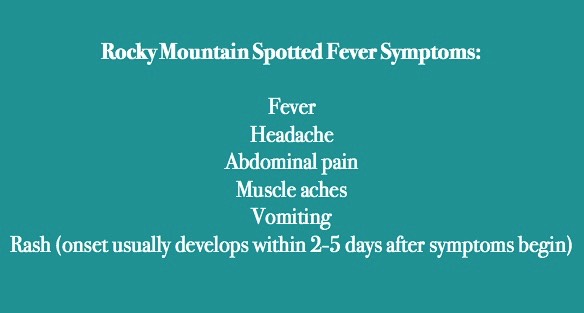
Most practitioners use Tetracycline antibiotics to treat the infection.
This infection can be deadly.
Photo credit: https://www.emedicinehealth.com/image-gallery/rocky_mountain_spotted_fever_hand_picture/images.htm

Photo credit: http://columbia-lyme.org/patients/tbd_spotted_fever.html
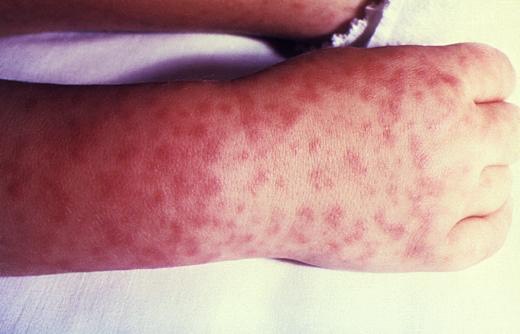
Photo credit: https://en.wikipedia.org/wiki/Rocky_Mountain_spotted_fever
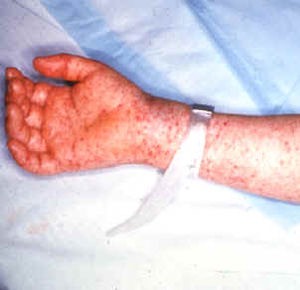
Photo credit: https://www.webmd.com/skin-problems-and-treatments/picture-of-rocky-mountain-spotted-fever

RMSF can have lingering or Chronic symptoms. Here are a few studies:
Bergeron JW, Braddom RL, Kaelin DL
Persisting impairment following Rocky Mountain Spotted Fever: a case report.Persisting impairment following Rocky Mountain Spotted Fever: a case report. [Case Reports, Journal Article]
Arch Phys Med Rehabil 1997 Nov; 78(11):1277-80.
A patient initially presented in the emergency room with fever, confusion, and a petechial rash. Rocky Mountain Spotted Fever (RMSF) was diagnosed and appropriate treatment was initiated. He subsequently became obtunded and required mechanical ventilation and temporary cardiac pacing. Four weeks later, he presented to our rehabilitation unit with ataxia, hyperreflexia and upper motor neuron signs, dysesthesias, sensorimotor axonopathy demonstrated by electrodiagnostic studies, and a global decrement in cognitive capability. Although he significantly improved in functional mobility and self-care, he exhibited little improvement in his cognitive impairment at 6-month follow-up. An understanding of the natural history of, and long-term impairments associated with, RMSF will be helpful to physiatrists in developing rehabilitation care plans and in assisting such patients with community re-entry.
Long-Term Sequelae of Rocky Mountain Spotted Fever
Lennox K. Archibald and Daniel J. Sexton 1995 The University of Chicago Press.
Abstract:
Twenty-five patients with definite or probable Rocky Mountain spotted fever (RMSF) who were hospitalized for ≥2 weeks were identified from our database of 105 patients. Follow-up information was collected for 20 patients, per telephone and/or medical records. The remaining five patients were lost to follow-up or died.
Nine patients had long-term sequelae (defined as complications related to an original acute infection with Rickettsia rickettsii that persisted for greater than 1 year following hospital discharge). The ages of patients with sequelae ranged from 2 to 74 years (mean and median, 38 years); duration of follow-up ranged from 1 to 18 years (mean, 11 years). The mean lengths of hospitalization for patients with and without long-term sequelae were 47 days and 20 days, respectively (P less then .05).
Long-term neurological sequelae included paraparesis; hearing loss; peripheral neuropathy; bladder and bowel incontinence; cerebellar, vestibular, and motor dysfunction; and language disorders. Nonneurological sequelae consisted of disability from limb amputation and scrotal pain following cutaneous necrosis. These data suggest that significant long-term morbidity is common in patients with severe illness due to RMSF.
---------
If you search 'Persisting RMSF following treatment', you will find more case studies.
The question that arises for me is, is this chronic RMSF or was the tick carrying an other pathogen that perhaps these docs were not testing for???